19. Full Basic Game Rules
Gameplay – Basic Game
Generals of Kaladan: Age of Crowns – Turn structure, control, movement, and battle systems
Once setup is complete, the armies of Kaladan march in strict sequence. Turn structure, control, movement, spawning, purchase rules, and battle outcomes all follow a disciplined order designed to keep the battlefield clear and decisive.
This section defines all gameplay systems for the standard basic game.
1. Turn Structure Overview
Each player completes a full turn consisting of six phases, always in this order:
- Event Phase
- Income Phase
- Free Spawn Phase
- Action Phase
- Purchase Phase
- Reinforcement Phase
Turn order is fixed once determined during setup and never changes.
2. Phase-by-Phase Breakdown
This is the exact turn sequence for each turn. It can also be found on the back of your realm card.
1. Event Phase
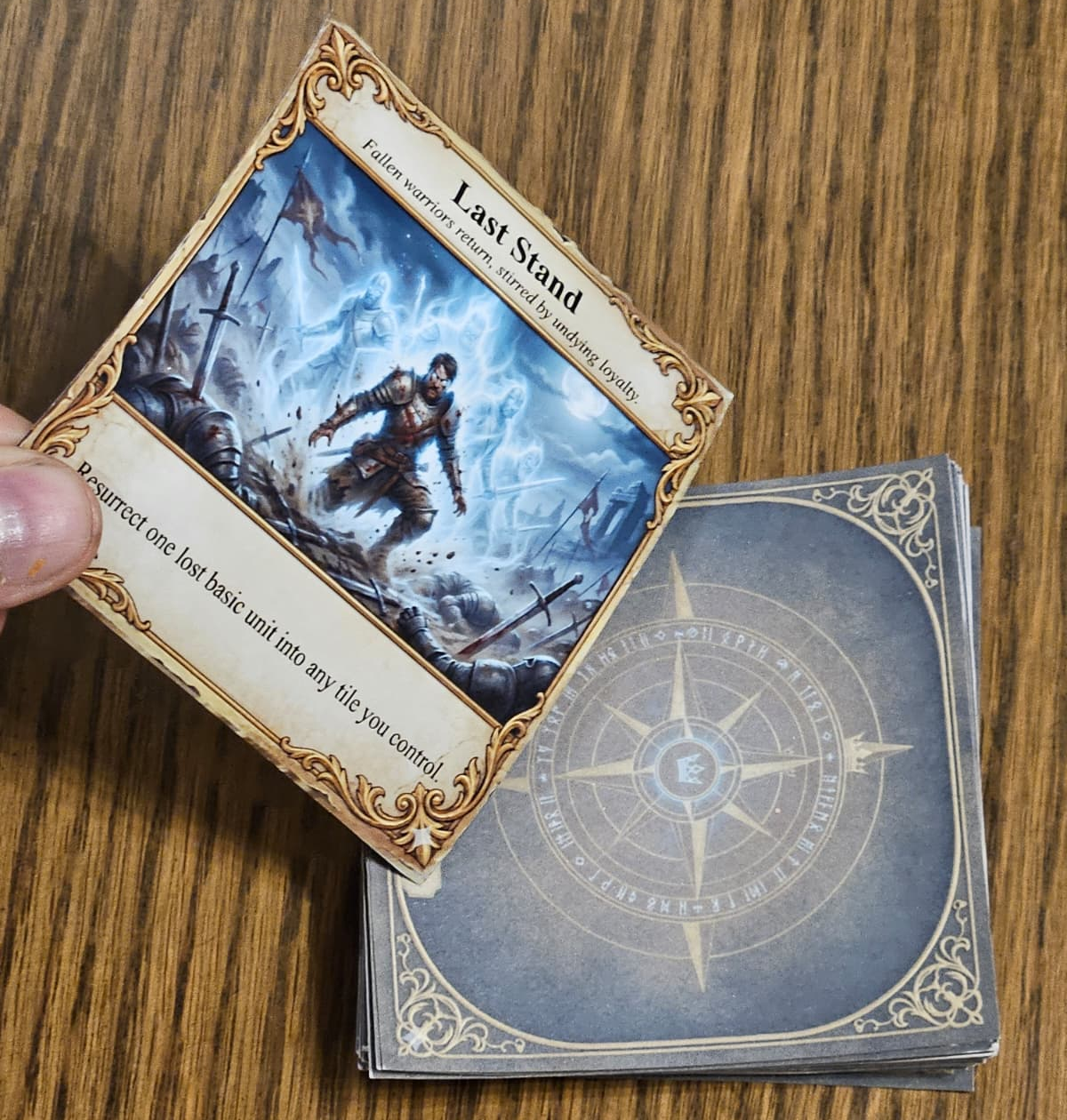
At the start of your turn, draw the top Event card and resolve it immediately.
There are two types of Event effects:
A. Player-Only Events
Affect only the player whose turn it is.
B. Global Events
Affect all players on the board.
Always follow the card text precisely.
Resolve the entire Event before moving to the Income Phase.
Event Card Rules:
Conditional Events:
Some event cards require conditions to be fulfilled. Players that do not fulfill the condition do not feel the impact of the event (positive or negative).
Example: "All Players With a Catapult on board gain 1 gold." If you do not have an active catapult on the board (not in your reserves) - you do not get gold.
Resurrection:
All resurrection action happens from dead units. Players can choose which player to resurrect from. If no units were dead in battle, you do not get to resurrect a unit.
Unit Types:
- Basic Units = Sword, Bow, Shield
- Advanced Units = General, Catapult
Upgrades:
Upgrade a unit by flipping it to the upgraded side. If event cards offer you an upgrade, this upgrade is free and does not cost any gold.
Upgrades can only happen to deployed / active units.
Poorest Player:
If tied, all players with shared least amount of gold get 1 gold.
2. Income Phase
You gain Gold based on tiles you actively control.
A tile is controlled only if at least one of your units is on it.
You do not control:
- Empty tiles you previously had units on
- Tiles you abandoned
- Tiles where your units were defeated
- Any tile with enemy presence (since two armies cannot share a tile)
Income rules:
- +1 Gold for each Castle you control
- +1 Gold for every 2 additional tiles you control (Castle tiles not included)
No rounding.
Examples:
- Player Controls Castle + 1 Mountain - Get 1 Gold
- Player Controls Castle + 1 Mountain + 1 Forest - Get 2 Gold
- Player Controls No Castle + 1 Mountain + 1 Field - Get 1 Gold
Add the gained Gold to your reserve.
3. Free Spawn Phase
Each Castle you control may spawn one free basic unit, if:
- The Castle tile has available capacity
- You have that unit available in your inventory
Free spawns are only basic units (any):
- Sword
- Bow (Archer)
- Shield
4. Action Phase
Choose one of the following actions:
- Move
- Swap
- Battle
Only one action can be taken during this phase.
A. Move
You may move units from one tile to an adjacent tile you control or that is empty.
Movement rules:
Multiple units may move only if:
- They all start on the same tile
- They all move to the same adjacent tile
- The destination has capacity for all moving units
You may not move into an enemy-controlled tile without initiating a battle.
B. Swap
You may swap units between two adjacent tiles you control.
Swap flexibility:
You may swap 1-to-1, 1-to-many, or many-to-1
As long as:
- Both tiles end within capacity
- Both tiles remain under your control
- No enemy tiles are involved
Swaps allow reorganization without movement limitations.
C. Battle
You may declare a battle against an enemy tile adjacent to one you control.
A battle occurs ONLY between two adjacent tiles – it's a tile-to-tile battle. All units on both tiles must participate in battle. There is no opt-out (unless paralyzed by Magic or Event Card). Paralyzed units can still be defeated in battle.
Defeating all enemy units in battle is the only way to enter an enemy tile.
Rules:
- You may initiate one battle per turn.
- You may only attack from one tile and attack a single opponent's tile. No multi-tile battles.
- Only one army may occupy a tile after battle—never both.
- Battle resolution uses the game's attack/defense dice system.
5. Purchase Phase
This phase is optional. You may buy units or choose to spend nothing.
Gold may be used to:
- Purchase and deploy units (details)
- Upgrade Units (see upgrades)
- Upgrade Castle – 4 Gold – an upgraded castle rolls a D8 when attacked (only on defense)
- Swap a magic card – 2 Gold
- Buy additional magic card – 4 Gold
Note: Only one magic card may be used at a time, even if you own multiple magic cards.
Purchased units may be deployed:
A. On a tile you control
- Must respect tile capacity
- Must obey all deployment rules
- Cannot exceed capacity for any reason
B. On a vacant tile adjacent to a tile you control
- The destination must be empty
- Must respect adjacency
- Must respect capacity
You may not deploy purchased units onto:
- Enemy-controlled tiles
- Tiles where you do not have adjacency
- Tiles beyond capacity
Additional notes:
- All purchased units must come from your inventory.
- Unit costs are shown directly on your Realm cards during gameplay.
Unit Costs:
All Basic Units (Sword, Bow, Shield):
- Deployment: 1 Gold
- Upgrade: 2 Gold
All Advanced Units (General, Catapult):
- Deployment: 2 Gold
- Upgrade: 3 Gold
6. Reinforcement Phase
After your Action Phase, you may perform one reinforcement maneuver:
- Move one unit between two adjacent tiles you control or onto a vacant adjacent tile, or
- Swap one unit between two adjacent controlled tiles
Reinforcement limitations:
- Optional
- Cannot exceed tile capacity
- Cannot cross into or through enemy tiles
After Reinforcement, your turn ends.
3. Control Rules
Control is strict and unambiguous:
You control a tile only if at least one of your units stands on it.
You lose control of a tile when:
- You move all units off it, leaving it empty, or
- All your units there are defeated in battle
Because two armies may never occupy the same tile, control is always clear.
4. Castle Control
Castle control:
If you defeat another player's Crown or they abandon their Castle and you move in to occupy it:
- You now control that Castle tile.
- You gain all Castle benefits from that tile, including:
- Its free unit spawn during the Free Spawn Phase (type determined by its terrain – if you have that unit in your reserves).
- +1 Gold coin at the beginning of every turn for each extra Castle you control.
- The eliminated player's army is removed from the board as per the core rules, but the Castle tile continues to function for its new owner.
- The defeated general's special unit joins the victor's reserves and may be deployed next turn for 2 gold.
5. Battle – High-Level Summary
(A full Battle section will detail target selection, dice pools, casualty order, and timing windows.)
These are the essential rules for battle in the basic game:
Battle Fundamentals
- Defeating all enemy units in battle is the only way to enter an enemy tile.
- You may only attack from one tile and attack a single opponent's tile. No multi-tile battles.
- A battle occurs ONLY between two adjacent tiles – it's a tile-to-tile battle.
- All units on both tiles must participate in battle. There is no opt-out (unless paralyzed by Magic or Event Card).
- Paralyzed units can still be defeated in battle.
- Outcomes are determined by rolling attack dice vs. defense dice.
- Armies from different realms cannot coexist on the same tile.
Magic Cards
Before a battle begins, either player (or both) may choose to use their magic card.
Declaration Order:
- The attacker declares first whether they wish to use a magic card.
- After the attacker's declaration, the defender may then decide whether to use a magic card.
Important: Magic cards must be declared before the battle commences. Once dice are rolled, it is too late to use magic.
If the attacker defeats all their opponents' defending units, the attacking army must:
Invade the tile with the maximum number of units allowed by the tile's capacity.
This is mandatory.
Examples:
- Attack from Forest (4 units) → Mountain (capacity 3)
→ Invade with 3 units - Attack from Mountain (3 units) → Field (capacity 4)
→ Invade with all 3 units
If the Defender Wins
- The defender stays on the tile.
- Defenders do not move after winning.
- Only the attacker's defeated units are removed.
Casualties
- Defeated units are removed from the board permanently.
- The owning general chooses which units are lost.
- Special Units are the only units that may return, following their unique respawn rules.
Crowns and Player Elimination
If a Crown is defeated:
- The player is eliminated immediately
- All their remaining units are removed from the board (They do not join any graveyards)
If the final battle was in the defeated player's castle, their Castle passes to the victor.
If the battle was not in the castle, castle becomes a free tile that can be occupied by any of the remaining players controlling it.
Their Special Unit transfers ownership and joins the victor's reserves and may be deployed next turn for 2 gold.
6. Ending the Game
The basic game ends when:
Only one Crown remains alive on the board.
That player becomes the sole ruler of Kaladan.
In the basic game, players may agree, before the game starts, that they will use the event cards as a timer.
When the event cards run out, if there is no winner, the players play one final round starting from the next player.
At the end of this round, points are tallied and a winner is declared.
Point System:
- 5 Points for every crown killed
- 3 points for every castle you control
- 2 points for every scalp you claimed
- 2 points for every tile you control other than castle