Team Mode
Team Mode
Alliances for the Crown: 2v2 and 3v3, from setup to the last Crown
Generals of Kaladan: Age of Crowns can also be played as a team game. Two or three generals ally under a shared banner against an opposing alliance. Team Mode keeps every strategic system of the basic game and removes player elimination. No general leaves the table early, and the war is decided by the fall of every opposing Crown, not the first.
Team Mode at a Glance
| Basic game | Team Mode | |
|---|---|---|
| Players | 2 to 6, every general for themselves | 2v2 (4 players) or 3v3 (6 players) |
| Seating | Any order | Allies sit in alternating seats |
| Table talk | Your plans are your own | Allies plan openly; no hidden hands between allies |
| Gold | Your own gold only | Kept on your own board; allies may transfer and spend each other's gold at any time |
| Sharing a tile | Never | Allies may share a tile up to its capacity; enemies never |
| Castle bonus | Each Castle you control | Each Castle you are present on, including an ally's |
| Your Crown falls | You are eliminated | You fight on with everything you have left |
| Your Special Unit | Passes to the general who felled your Crown | Stays with you |
| Victory | Last Crown standing | Every opposing Crown has fallen |
| Points | Per player | Per team |
Setting Up a Team Game
Step 1: Form the Teams
Agree on the format before setup: 2v2 with 4 players, or 3v3 with 6 players. Allies sit in alternating seats around the table, so clockwise turn order naturally alternates between the two sides.
Example for 2v2: Team A, Team B, Team A, Team B around the table.
Step 2: Determine Turn Order
- Each player rolls a 12-sided die (D12).
- The highest roll becomes First Player. Tied players reroll.
- Turn order is clockwise. Because of the seating, turns alternate between the teams.
Step 3: Build the World
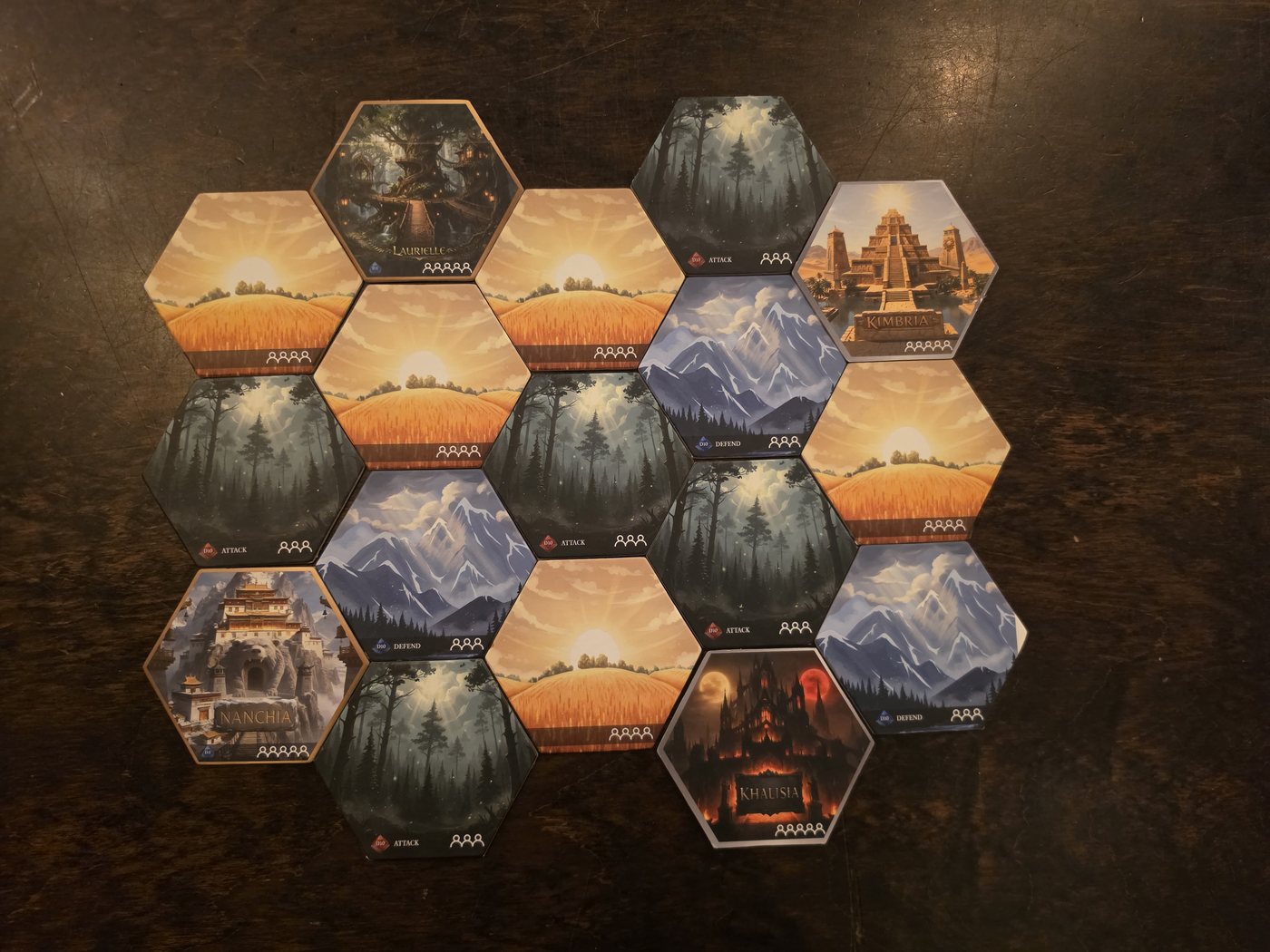
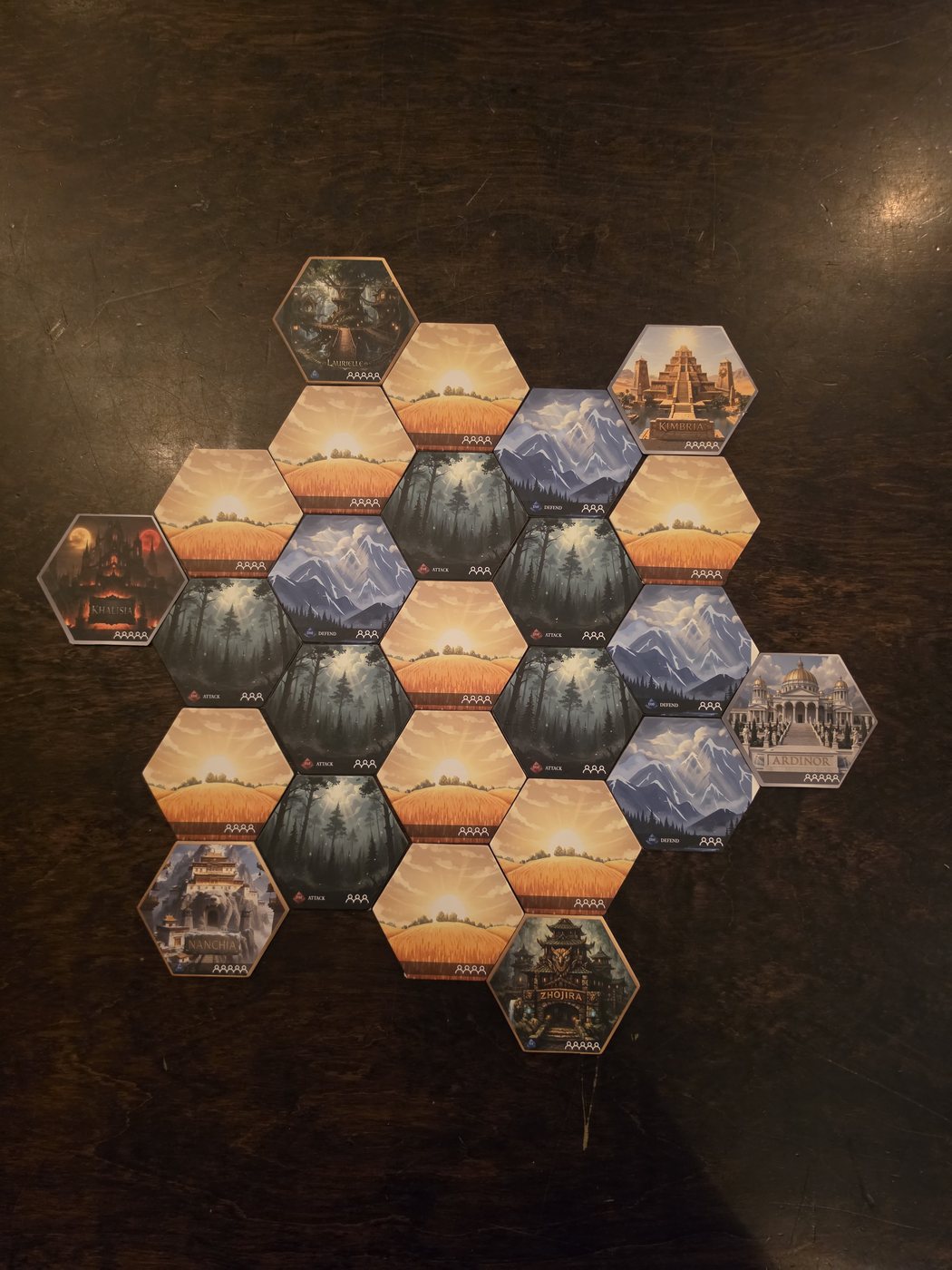
Build the standard world for the total number of players, exactly as in the basic game: the 4 player world for 2v2, the 6 player world for 3v3. See Setting Up for the layouts and the random world building option.
2v2: the 4 player world
3v3: the 6 player world
Step 4: Choose Realms, Alternating Between Teams
Starting with the First Player and following the seating, players choose realms one at a time, so the choice alternates between the teams. A realm already claimed cannot be taken again.
Each player receives, exactly as in the basic game:
- That Realm's Player Board
- A Castle tile
- The Realm's Special Unit
- The Realm Card
- The Realm's Magic Cards (choose 1 to start with)
Your starting Magic card stays hidden from the opposing team. Your allies may see it.
Step 5: Place Castles in Reverse Turn Order
The last player places first and the First Player places last. Because seating alternates, castle placement also alternates between the teams, giving each alliance an equal say in shaping the opening fronts. Use the Castle positions for 4 or 6 players from Setting Up.
Step 6: Initial Deployment
Each player deploys on their own Castle tile, as in the basic game:
- Crown
- Special Unit
- 1 General
- 1 basic unit of your choice (Sword, Archer or Shield)
Step 7: Event Deck, Gold and Reserves
- Event deck: shuffle it as in the basic game and shuffle 1 End Game Event card into the last 8 cards (or play without one, if all players agree).
- Starting gold: as in the basic game, in ascending turn order. The First Player receives 0 Gold, player 2 receives 1, player 3 receives 2, and so on. Each player keeps their gold on their own player board.
- Reserves: unchanged. All units not deployed stay on your player board as your reserves.
The War Council
Team Mode is a game of alliance, not secrecy. Allies may discuss, plan and decide together at any point in the game, including:
- Which action to take, which tile to contest and which unit to deploy
- Gold spending, transfers and joint purchases
- Battles, Magic card use, reinforcements and defensive positions across each other's turns
- Openly reviewing each other's Magic cards, Realm Cards and reserves
There are no hidden hands between allies. The opposing team may listen in, so treat every conversation at the table as part of the game.
Your Turn in Team Mode
Play is turn based and every player takes a full turn of six phases, in the usual order. Because of the seating, turns alternate between the teams. These are the team rules phase by phase.
1. Event Phase
Draw and resolve the top Event card as in the basic game. Event cards are judged per player, not per team:
- Richest Player: the player with the most gold on their own board. Ties include all tied players, from either team.
- Strongest Player: the player with the most of their own units on the board. Ties include all tied players.
- Gold an Event gives you goes onto your own board. Gold an Event takes comes from your own board.
- Conditional Events check your own units only. An ally's Catapult does not count as yours.
2. Free Spawn Phase
For each Castle tile you are present on at the start of your turn, your own or an ally's, you may spawn one free basic unit onto that Castle tile, if:
- The Castle tile has capacity left
- You have that unit available in your reserves
Free spawns only ever go onto Castle tiles. Two allies on the same Castle each spawn there in their own turn, capacity permitting.
3. Income Phase
- +1 Gold for each Castle tile you are present on, your own or an ally's.
- +1 Gold for every 2 other tiles where at least one of your units stands.
- A tile you share with an ally counts for you, and it counts for your ally in their own Income Phase.
- Your income goes onto your own board.
4. Action Phase
Choose one action, as in the basic game: Move, Swap or Battle. You command only your own units.
- Move: move your units to an adjacent tile that is empty, held by you, or held by an ally, within capacity.
- Swap: swap your own units between two adjacent tiles where you have units. Allied units stay where they are.
- Battle: declare a battle against an adjacent enemy tile. See Battles on Shared Tiles below.
5. Purchase Phase
- Spend your own gold, your allies' gold, or both.
- Deploy purchased units onto a tile you or an ally holds, within capacity.
- Or deploy onto one vacant tile adjacent to a tile you or an ally holds, following the normal deployment rules as if you held that tile yourself.
- Purchased units always come from your own reserves.
- Magic cards are bought or swapped from your own realm's deck, as in the basic game.
6. Reinforcement Phase
As in the basic game, with your own units only. You may never move an ally's units.
Fallen Crowns Fight On
There is no player elimination in Team Mode. If your Crown is defeated:
- You stay in the game and keep taking a full six-phase turn every round.
- You keep your Special Unit.
- All your undefeated units stay on the board and in your reserves.
- You keep your Magic cards and may still play them.
- You keep earning, holding and spending gold, and may still spawn, purchase, deploy and battle.
Your Castle
- If your Crown fell in battle on your Castle tile, the Castle passes to the victor, as in the basic game.
- If your Crown fell anywhere else, your Castle stays yours for as long as your units stand on it. If it is ever left empty, it becomes a free tile that any player may occupy.
What the Victor Gains
- The fallen Crown counts for the victor's team at the points tally.
- The fallen player's Special Unit does not change sides, and their Magic cards cannot be bought by the victor.
Victory
When the Game Ends on the Event Deck
If an End Game Event is drawn, or the Event deck runs out, before a team has fallen, play one final round starting from the next player, exactly as in the basic game. Then tally points per team. The team with the higher combined total wins.
Team Points
- 5 points for every opposing Crown defeated
- 3 points for every Castle your team controls
- 2 points for every scalp your team claimed (every enemy unit your team defeated in battle, including assassinated units: the units in all allied graveyards. Units removed by Event cards are not scalps)
- 1 point for every non-Castle tile your team controls
- 1 point for every 2 gold your team still has, all allied boards added together
A tile shared by allies counts once for the team. Tie breakers follow the basic rules, compared team against team.
Team Mode Questions
| Question | Ruling |
|---|---|
| Can I attack from a tile I share with an ally? | Yes, on your turn. All units on that tile, yours and your ally's, fight in the battle. |
| Can I move or swap my ally's units? | No. Only during a mandatory invasion may allied units from the winning battle be moved into the invaded tile. |
| My ally and I both stand on my Castle. Who gets the Castle bonus? | Both of you, each in your own turn: +1 Gold and one free spawn on that Castle, capacity permitting. |
| Who is the Richest Player when we keep our gold apart? | The single player with the most gold on their own board, from either team. |
| Does my ally's gold protect me from an Event that takes gold? | No. The Event takes gold from your own board only. |
| My Crown has fallen. Can I still win? | Yes. Your team wins when every opposing Crown has fallen, and your units keep fighting for it. |