3. Gameplay and Rules
Game Play
Turn structure, control, movement, and battle systems
Once setup is complete, the armies of Kaladan march in strict sequence. Turn structure, control, movement, spawning, purchase rules, and battle outcomes all follow a disciplined order designed to keep the battlefield clear and decisive. This section defines all gameplay systems for the standard basic game.
Turn Structure Overview
Each player completes a full turn of six phases, always in this order:
- Event Phase
- Free Spawn Phase (optional)
- Income Phase
- Action Phase (optional)
- Purchase Phase (optional)
- Reinforcement Phase (optional)
1. Event Phase
At the start of your turn, draw the top Event card and resolve it immediately.
There are two types of Event effects:
- A. Player-Only Events: affect only the player whose turn it is.
- B. Global Events: affect all players on the board.
Always follow the card text precisely. Resolve the entire Event before moving to the Free Spawn Phase.
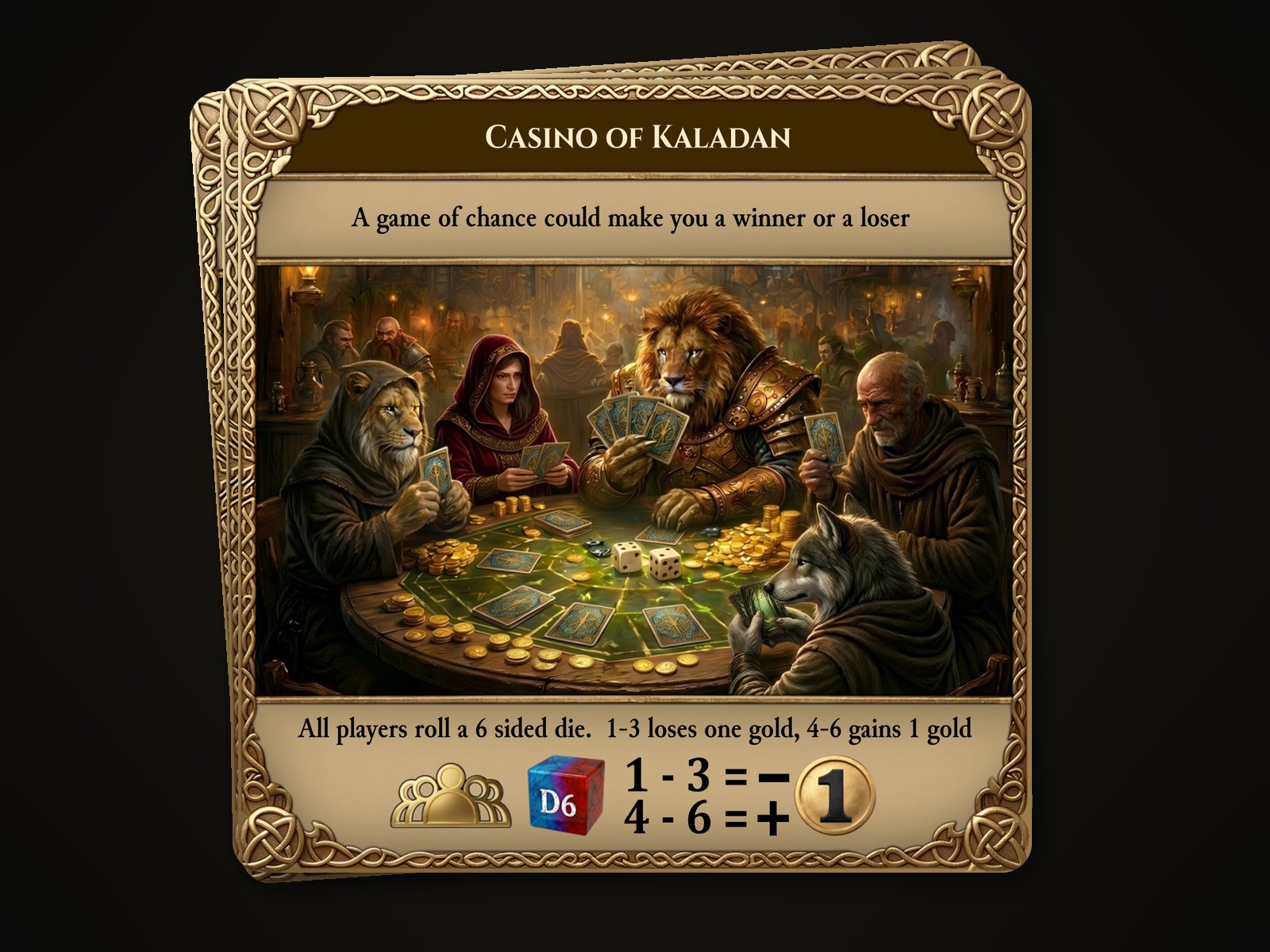
Event Card Rules
Conditional Events
Some Event cards only apply if a condition is met. Players who do not meet the condition are not affected by the event, positively or negatively. Example: "All players with a Catapult on the board gain 1 gold." If you have no Catapult on the board (units in your reserves do not count), you do not get the gold.
Resurrection
All resurrection happens from your own dead units. Players can choose which player to resurrect from. If no units have died in battle, you do not get to resurrect a unit. You may resurrect basic or advanced units. A defeated upgraded unit loses its upgrade and is not resurrected as an upgraded unit.
Upgrades
Upgrade a unit by flipping it to its upgraded side. If an Event card offers you a free upgrade, it costs no gold. Upgrades can only be applied to deployed (active) units.
Richest Player
If tied, all players sharing the most gold are included.
Strongest Player
The player with the most units on the board. If tied, the effect applies to all tied players.
2. Free Spawn Phase
Each Castle you control may spawn one free basic unit of your choice, if:
- The Castle tile has available capacity
- You have that unit available in your reserves
Free spawns are only basic units (any): Sword, Bow (Archer) or Shield.
3. Income Phase
You gain Gold based on the tiles you actively control.
A tile is controlled only if at least one of your units is on it.
You do not control:
- Empty tiles you previously had units on
- Tiles you abandoned
- Tiles where your units were defeated
- Any tile with enemy presence (two armies cannot share a tile)
Income Rules
- +1 Gold for each Castle you control
- +1 Gold for every 2 additional tiles you control (Castle tiles not included)
Examples
- Castle + 1 Mountain: 1 Gold
- Castle + 1 Mountain + 1 Forest: 2 Gold
- No Castle + 1 Mountain + 1 Field: 1 Gold
Add the gained Gold to your reserve.
4. Action Phase
Choose one of the following actions: Move, Swap or Battle. Only one action can be taken during this phase, and the phase is optional.
A. Move
You may move units from one tile to an adjacent tile you control or that is empty.
Multiple units may move together only if:
- They all start on the same tile
- They all move to the same adjacent tile
- The destination has capacity for all moving units
You may not move into an enemy-controlled tile without initiating a battle.
B. Swap
You may swap units between two adjacent tiles you control: 1-to-1, 1-to-many, or many-to-1, as long as:
- Both tiles end within capacity
- Both tiles remain under your control
- No enemy tiles are involved
Swaps allow reorganisation without movement limitations.
C. Battle
You may declare a battle against an enemy tile adjacent to one you control. Full rules and steps are in the Battle section.
- You may initiate one battle per turn.
- You may only attack from one tile, against a single opponent's tile. No multi-tile battles.
- Only one army may occupy a tile after battle, never both.
- Battle resolution uses the game's attack and defense dice system.
5. Purchase Phase
This phase is optional. You may buy units or choose to spend nothing. Gold may be used to:
- Purchase and deploy units
- Upgrade units (see upgrades)
- Upgrade your Castle: 4 Gold. An upgraded castle rolls a D8 when attacked (defense only).
- Swap a Magic card: 2 Gold
- Buy an additional Magic card: 4 Gold
Purchased units may be deployed:
A. On a tile you control
- Must respect tile capacity
- Must obey all deployment rules
- Cannot exceed capacity for any reason
B. On only one (1) vacant tile adjacent to a tile you control
- The destination must be empty
- Must respect adjacency
- Must respect capacity
You may not deploy purchased units onto:
- Enemy-controlled tiles
- Tiles where you do not have adjacency
- Tiles beyond capacity
- More than one empty tile
All purchased units must come from your reserves.
Unit Costs
| Unit | Deployment | Upgrade |
|---|---|---|
| Basic units (Sword, Bow, Shield) | 1 Gold | 2 Gold |
| Advanced unit: Catapult | 2 Gold | 3 Gold |
| General | 2 Gold | 4 Gold |
| Special Units | 2 Gold to respawn | 2 Gold |
6. Reinforcement Phase
After your Purchase Phase, you may perform one reinforcement manoeuvre:
- Move one unit between two adjacent tiles you control, or onto a vacant adjacent tile, or
- Swap one unit between two adjacent controlled tiles
Reinforcement Rules and Limitations
- Optional
- Cannot exceed tile capacity
- Cannot cross into or through enemy tiles
After Reinforcement, your turn ends.
Tile Control Rules
Control is strict and unambiguous.
You control a tile only if at least one of your units stands on it.
You lose control of a tile when:
- You move all units off it, leaving it empty, or
- All your units there are defeated in battle
Because two armies may never occupy the same tile, control is always clear.
Castle Control
If you defeat another player's Crown, or they abandon their Castle and you move in to occupy it:
- You now control that Castle tile.
- You gain all Castle benefits from that tile, including its free unit spawn during the Free Spawn Phase (if you have basic units in your reserves).
- +1 Gold coin at the beginning of every turn for each extra Castle you control.
- The eliminated player's army is removed from the board as per the core rules, but the Castle tile keeps working for its new owner.
- The defeated general's Special Unit joins the victor's reserves and may be deployed next turn for 2 gold.
- Any unused Magic cards from the defeated player's realm can now be bought by the player who defeated them, for 4 gold.
Terrain Types and Bonuses
There are 3 terrain types in the game:
| Terrain | Max capacity | Battle bonus |
|---|---|---|
| Field | 4 units | None |
| Mountain | 3 units | If attacked IN a Mountain, roll an extra D10 and discard your lowest roll |
| Forest | 3 units | If attacking FROM a Forest, roll an extra D10. Do NOT discard your lowest roll |
More detail in Terrains.
Ending the Game
The basic game ends when:
Only one Crown remains alive on the board. That player becomes the sole ruler of Kaladan.
or
The Event cards run out. If there is no winner, the players play one final round starting from the next player. At the end of that round, points are tallied and a winner is declared.
Point System
- 5 points for every Crown killed
- 3 points for every Castle you control
- 2 points for every scalp you claimed (a scalp is any enemy unit you defeated in battle, including assassinated units: the units in your graveyard. Units removed by Event cards are not scalps)
- 1 point for every tile you control other than a Castle
- 1 point for every 2 gold coins you still have
Tie Breakers (in order)
- More units remaining on the board
- More units remaining in reserve
- If all else fails, a final roll: each player rolls a D6, D8, D10 and D12 (one of each), and the higher total is declared the Victor.